The History of Shree Lipi Font System
Before Unicode became the global standard for text encoding, Indian language computing ran on a collection of proprietary font systems — each solving the same fundamental problem in its own way. Among all of them, Shree Lipi — developed by Modular Infotech in Pune — became the most trusted, most widely adopted, and most enduring system for Devanagari script typography across India.
To understand why Shree Lipi matters even today, you need to understand what it solved, how it grew, and why the enormous archive of Shree Lipi content created over three decades continues to make this font system relevant in the era of Unicode.
Key Takeaways
- Pioneering System: Shree Lipi, launched in 1991 by Modular Infotech, revolutionized Devanagari DTP by creatively mapping characters to ASCII.
- Industry Standard: It quickly became the dominant typesetting tool for Indian newspapers, book publishers, and government presses.
- Massive Library: Offers over 1,000 Devanagari typefaces, including the famous ornamental Bahar series.
- Continued Relevance: Despite Unicode's dominance in digital media, Shree Lipi is heavily relied upon in offset printing and archival retrieval.
- Conversion Need: A dedicated Unicode to Shree Lipi Converter is essential to bridge modern text input with legacy printing workflows.
Table of Contents
- The Problem Shree Lipi Was Built to Solve
- Modular Infotech — The Company Behind Shree Lipi
- The Launch of Shree Lipi 1.0 (1991)
- The Golden Age — 1990s to Mid-2000s
- The Font Library — What Made Shree Lipi Unique
- Version History — How Shree Lipi Evolved
- The Awards and Recognition
- The Unicode Challenge and Shree Lipi's Response
- Why Shree Lipi Still Matters Today
- The Role of Unicode in Shree Lipi Conversion
- Shree Lipi in the Modern Era — NXT Plus and Beyond
- Conclusion
- Frequently Asked Questions
The Problem Shree Lipi Was Built to Solve
In the late 1980s, the Indian printing industry was undergoing a transformation. Computerized desktop publishing was arriving — but the technology had been built entirely around Latin script. Operating systems, fonts, and DTP software were all designed for alphabets like English, French, and German. Devanagari script, with its complex character set, half-forms, conjuncts, and matras, was a completely different challenge.
The core problem was rendering. Early PC hardware could not natively handle Devanagari's complexity. Conjuncts like क्ष and त्र, matras that appear above, below, and around consonants, and the horizontal shirorekha line connecting characters — all of this required a level of rendering intelligence that early software simply did not have.
The workaround that the Indian software industry developed was elegant in its simplicity — map Devanagari characters to the existing positions in the ASCII character table. A standard English keyboard pressing "d" might produce "क" when a Shree Lipi font was applied. The font file itself contained carefully drawn Devanagari glyph shapes mapped to ASCII positions. The DTP software saw normal ASCII text, but through the lens of the Shree Lipi font, that text was rendered as perfectly formed Devanagari script.
This was the foundational idea behind all legacy Hindi and Marathi font systems — and Modular Infotech turned it into an industry-leading product.
Modular Infotech — The Company Behind Shree Lipi
Modular Infotech Pvt. Ltd. was established in Pune, India in 1983, not as a font company, but as a technology company dedicated specifically to Indian language computing. This early focus on Indian scripts, years before desktop publishing arrived in India, gave Modular Infotech a head start that no competitor could easily replicate.
Their first product was a CRT-based phototypesetter called PTS100, launched in 1987. This machine was built for the Indian printing industry and used proprietary font formats developed entirely in-house — because at that time, no standard font generation tools existed that could handle complex Indian scripts.
By 1989, Modular launched DOS-based DTP software paired with Indic keyboard handlers and their proprietary font format. This software gave Indian printing presses and publishers their first real computerized DTP capability for Hindi and Marathi content. The market reception was enthusiastic — these tools solved real, pressing problems that had remained unaddressed for years.
As the industry shifted from DOS to Windows in the early 1990s, Modular Infotech adapted quickly. They transitioned their font library to TrueType (TTF) and Adobe Type1 formats, which were the emerging industry standards for Windows-based DTP. This transition culminated in the launch of their flagship product — Shree Lipi 1.0 — in 1991.
The Launch of Shree Lipi 1.0 (1991)
Shree Lipi 1.0 was not simply a font — it was a complete DTP ecosystem for Indian languages. It bundled:
- A large library of original Devanagari typefaces, each hand-crafted by collaborating with artists and calligraphers across India. These were not generic fonts — they were designed with the aesthetic sensibility of Indian printing, capturing everything from the clean rationality of newspaper body text to the ornamental complexity of invitation card headings.
- A keyboard input system that handled the translation between English keystrokes and Devanagari character output through the ASCII mapping approach.
- A set of DTP utilities specifically for Indian language workflows — including tools for text composition, character spacing, and print output that understood the specific requirements of Devanagari typography.
- Support for PageMaker, CorelDRAW, and other Windows DTP applications that were becoming the industry standard for professional print production.
The timing was perfect. India's printing and publishing industry was computerizing rapidly in the early 1990s. Newspapers, book publishers, government printing presses, and DTP studios all needed a reliable, professional-quality solution for Hindi and Marathi typesetting. Shree Lipi 1.0 arrived at exactly the right moment with exactly the right set of capabilities.
The Golden Age — 1990s to Mid-2000s
Through the 1990s and into the mid-2000s, Shree Lipi became the de facto standard for professional Devanagari DTP across India. Its adoption was broad and deep — spanning industries, regions, and use cases that no other single font system could match.
Hindi and Marathi Newspapers
The newspaper industry was Shree Lipi's largest and most demanding customer. Major Hindi and Marathi dailies adopted Shree Lipi for their entire page layout workflow — from headlines and subheadings to body text and captions. The font system's ability to render clean, readable Devanagari at the small point sizes used for newspaper body text (typically 8pt to 10pt) was critical. Shree Lipi's typefaces were optimized for exactly this kind of high-volume, readability-first printing.
Government Printing
State and central government printing presses across multiple states standardized on Shree Lipi for official documents, gazettes, legislative records, and government publications in Hindi and Marathi. The system's reliability and the breadth of its font library made it the practical choice for government DTP departments that needed consistent, professional output.
Book Publishing
Hindi and Marathi book publishers adopted Shree Lipi for body text, chapter headings, and cover design. The font library's variety — from traditional book typefaces to display fonts — gave publishers everything they needed without sourcing from multiple vendors.
DTP Studios and Printing Presses
Independent DTP studios and commercial printing presses across Maharashtra, Madhya Pradesh, Uttar Pradesh, Gujarat, and other Hindi-belt states built their entire workflows around Shree Lipi. The system worked reliably with PageMaker 6.5 and 7.0, CorelDRAW, and other professional DTP applications.
By the time Shree Lipi had reached version 7.1, it had accumulated a user base of over 250,000 authorized users — making it the most widely deployed Indian language DTP system in the country.
The Font Library — What Made Shree Lipi Unique
One of the defining strengths of Shree Lipi was the sheer breadth and quality of its font library. Where competitors might offer a handful of Devanagari typefaces, Modular Infotech built one of the most extensive collections of original Indian language fonts in existence.
The Shree Lipi font library includes over 1,000 Devanagari typefaces. These range from functional, workhorse fonts designed for newspaper and book body text — clean, highly legible, optimized for small sizes — to elaborate display fonts designed for headings, banners, and advertising.
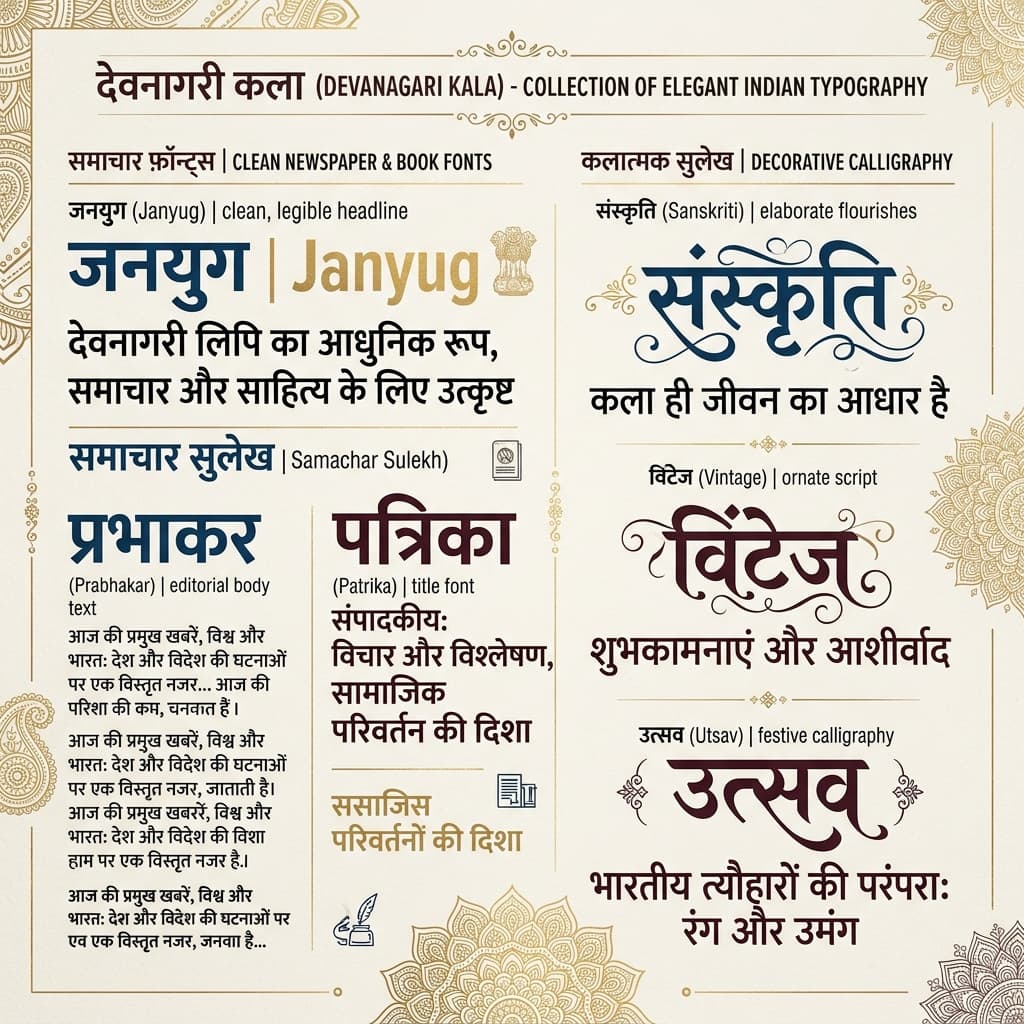
The Bahar Series is the most celebrated segment of the Shree Lipi font collection. These are decorative Devanagari fonts with up to 4,400 variations, combining traditional calligraphic forms with ornamental detail. The Bahar series became the standard choice for wedding cards, festival invitations, religious publications, and any printing that required a festive or ceremonial aesthetic.
Modular Infotech collaborated extensively with artists and calligraphers across India to create this library — not generating fonts algorithmically, but working with human designers who understood the aesthetic and cultural nuances of Devanagari script in different regional contexts. This approach produced fonts that felt authentic to their intended use cases in ways that mechanically generated fonts could not.
Beyond Devanagari, the Shree Lipi system expanded to cover over 15 Indian languages — Gujarati, Gurmukhi, Bengali, Assamese, Manipuri, Odia, Tamil, Kannada, Telugu, Malayalam, and Vedic Sanskrit, among others. Language-specific packages were released including DevRatna for Hindi and Marathi, Gurjari for Gujarati, Gurumukhi for Punjabi, and BangaRatna for Bengali. This multi-language capability made Modular Infotech the reference vendor for organizations that needed pan-Indian language DTP capability.
Version History — How Shree Lipi Evolved
From its 1991 launch through to the present, Shree Lipi has gone through continuous development across seven major versions. Each version added capabilities, expanded the font library, and maintained compatibility with the evolving Windows ecosystem.
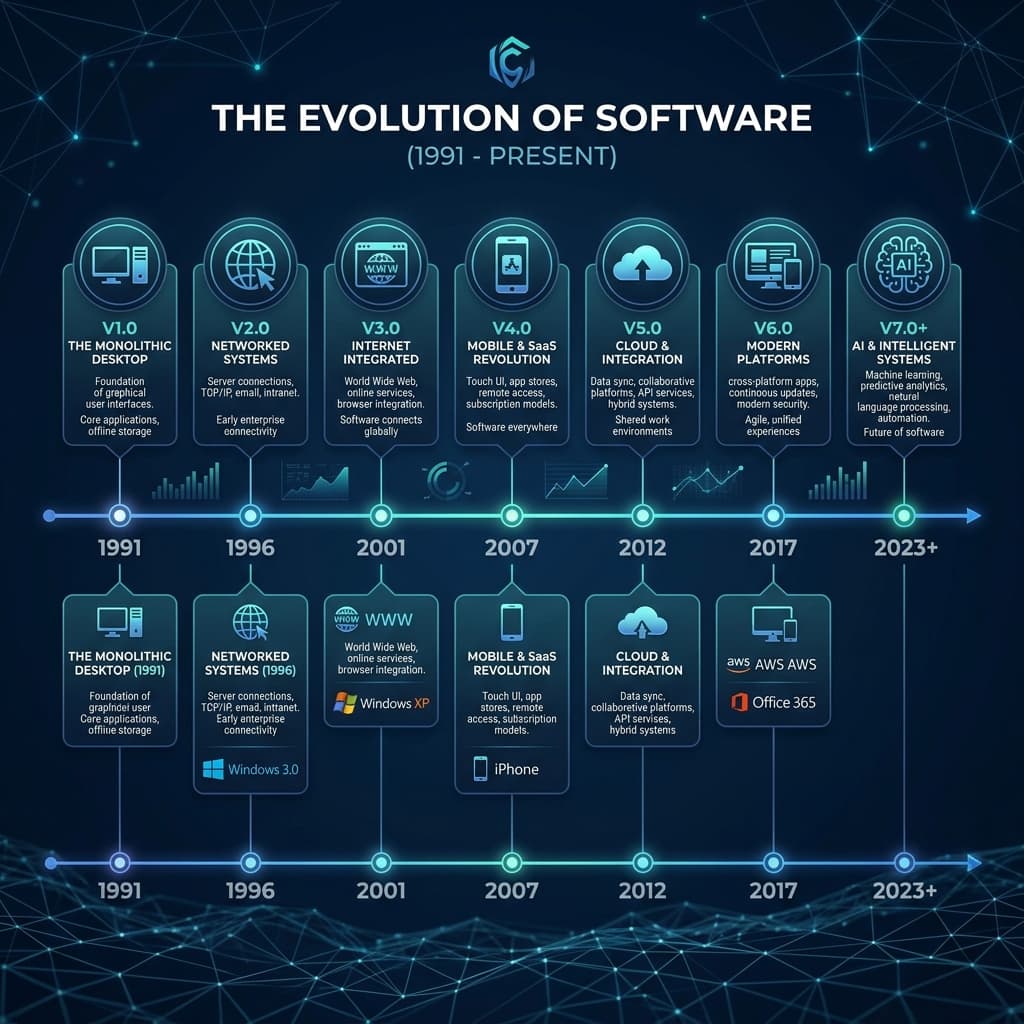
Shree Lipi 1.0 (1991)
The original launch. Established the core ASCII-mapping approach for Devanagari typography. Bundled a substantial library of Hindi and Marathi fonts. Supported DOS and early Windows environments.
Shree Lipi 2.0 through 4.0 (Mid 1990s)
Progressive expansions of the font library. Added support for Windows 95 and Windows 98. Refined keyboard input handling. Expanded language coverage. Added compatibility with PageMaker and CorelDRAW as these became the professional DTP standard.
Shree Lipi 5.0 and 6.0 (Late 1990s to Early 2000s)
Major updates to maintain compatibility with Windows 2000, ME, and Windows XP. Expanded language support. Added utilities for font conversion and document processing. These versions saw the peak of Shree Lipi's market dominance before Unicode began to challenge the legacy font model.
Shree Lipi 7.0 and 7.1 (Mid 2000s)
The mature form of the classic Shree Lipi system. By version 7.1, the software supported over 250,000 authorized users and had accumulated a font library covering thousands of typefaces across all major Indian scripts. Received the PC Quest Users Choice Award and recognition from India's Ministry of Information Technology.
Shree Lipi NXT Plus (2021 onwards)
The contemporary version of Shree Lipi, designed to bridge legacy and modern workflows. NXT Plus adds Unicode composition support — meaning users can work in Unicode and use the system's conversion tools to produce legacy Shree Lipi output. It also adds compatibility with open-source applications (LibreOffice, GIMP, Inkscape, Scribus) and modern workflows. As Shree Lipi completed 32 years, NXT Plus represents the system's adaptation to the Unicode era without abandoning the legacy font archive.
The Awards and Recognition
Shree Lipi's impact on Indian language computing earned recognition from multiple organizations:
- In August 2000, Shree Lipi received the PC Quest Users Choice Award — one of the most respected technology awards in India at the time.
- In 2001, Modular Infotech received the "Award for Best Computer Package in Hindi" (Second Prize) from India's Ministry of Information Technology — recognizing both Shree Lipi Suchika and the bilingual accounting package ArthaLekha.
- In 2002, Dr. M. N. Cooper, Chairman and Joint Managing Director of Modular Infotech, received the Manthan Award from Manthan Pratishthan for technical achievement in Indian language computing.
- Mrs. Meena R. Joshi, Technical Director of the company, received the Marathi-Ratna Puraskar from The Institution of Engineers India — recognizing her contribution to Marathi language technology.
Today, Modular Infotech's fonts are used by international technology companies including Google, Microsoft, Apple, and Red Hat — testament to the quality and technical sophistication of the company's work in Indic typography.
The Unicode Challenge and Shree Lipi's Response
When Microsoft introduced comprehensive Unicode support through Windows XP and the Mangal font in the early 2000s, it fundamentally changed Indian language computing. Unicode offered something that the ASCII-mapping legacy font approach could never provide — universality.
A document typed in Mangal Unicode could be opened on any device, in any country, without the Mangal font needing to be installed. It could be searched, indexed by Google, submitted to government portals, and shared via email or WhatsApp without any font dependency. Legacy Shree Lipi text, by contrast, appeared as meaningless English characters on any system without the Shree Lipi fonts installed.
For new digital-first content — websites, email, mobile apps, government digital services — Unicode became the clear choice almost immediately. The practical advantages were too significant to ignore.
But legacy systems do not simply disappear. They persist in proportion to the volume of content already created in them — and Shree Lipi had three decades of content creation behind it.
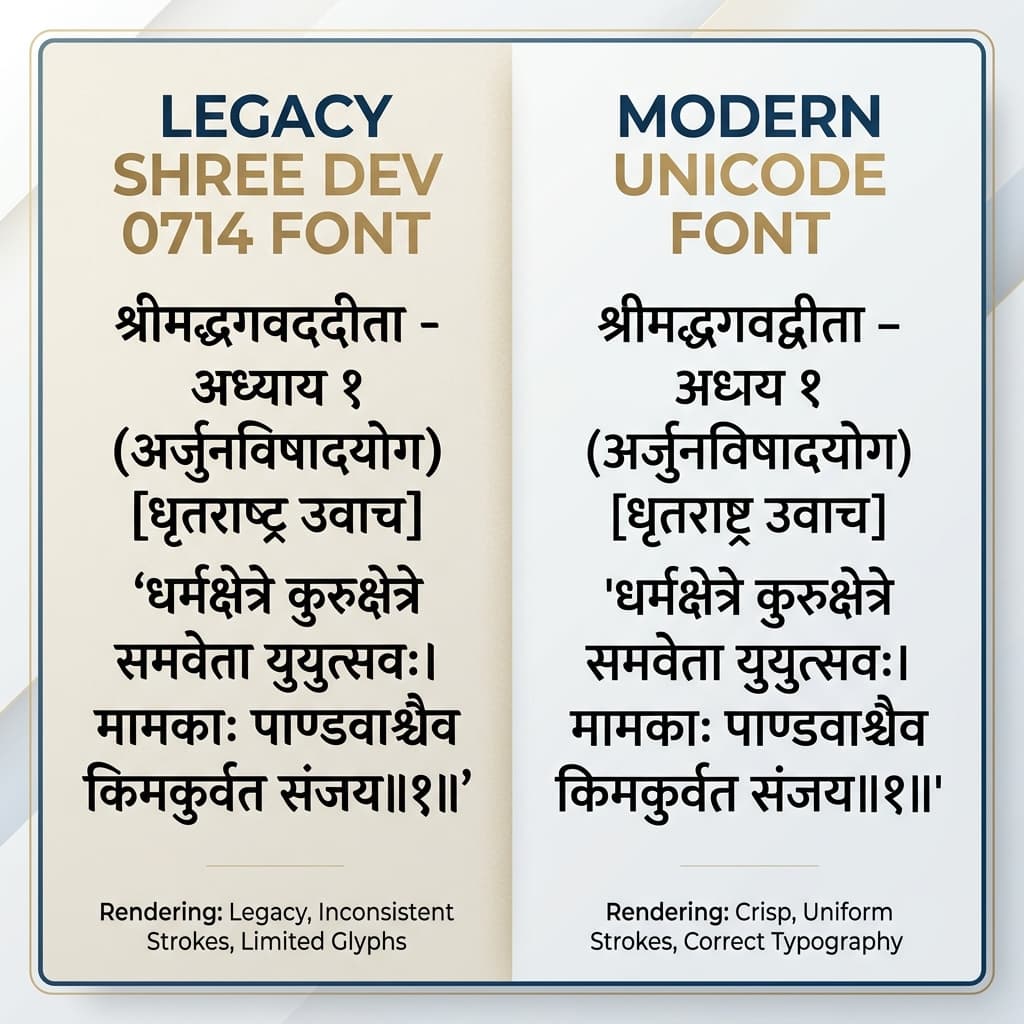
Comparison: Shree Lipi (Legacy) vs Unicode
| Feature | Shree Lipi (Legacy) | Unicode |
|---|---|---|
| Encoding Type | Proprietary ASCII mapping | International standard (ISO/IEC 10646) |
| Works Without Font Installed | No — font must be on every device | Yes — works on any modern device |
| Web and Mobile Compatible | No | Fully compatible |
| Searchable Text | No — stored as ASCII characters | Fully searchable in any application |
| Font Variety | 1,000+ typefaces, including ornamental Bahar series | Growing but limited compared to legacy library |
| Ideal For | Professional print DTP, newspapers, wedding cards, archived documents | Digital publishing, web, mobile, government portals, modern documents |
| DTP Software | PageMaker, CorelDRAW, older InDesign | All modern software — MS Word, InDesign, Google Docs |
Why Shree Lipi Still Matters Today
Three decades of content does not vanish when a new standard arrives. Across India, an enormous volume of documents, newspaper archives, published books, government records, and institutional files exist in Shree Lipi format. This content is not obsolete — it needs to be accessed, reprinted, revised, and in many cases converted to Unicode for digital use.
This is the first reason Shree Lipi still matters: the archive. Anyone working with historical Hindi or Marathi printed content will encounter Shree Lipi files. DTP operators, archivists, newspaper editors reviewing old editions, publishers reprinting older titles — all of them need to work with Shree Lipi-encoded content regularly.
The second reason is the printing industry's installed base. Hundreds of printing presses across smaller cities and towns in India still run PageMaker 6.5 or 7.0 with Shree Lipi as their primary typography system. These presses have invested in templates, training, and workflows built around Shree Lipi over the years. Replacing the entire system is not a trivial decision — it requires capital, retraining, and rebuilding templates. For many regional presses, the existing system works well for their current needs, and the investment in upgrading is not justified.
The third reason is the font aesthetic. Even in a world where Unicode fonts are available, the Shree Lipi font library — particularly the Bahar decorative series — offers a level of calligraphic variety and artistic richness that Unicode Devanagari fonts simply cannot match. Wedding card designers, festival poster artists, and religious publication designers continue to work in Shree Lipi because the visual output is qualitatively different from what Unicode fonts produce.
This is also why the intersection of Unicode and Shree Lipi remains an active, daily workflow challenge — and why tools that bridge the two systems continue to serve a real professional need.
The Role of Unicode in Shree Lipi Conversion
For professionals who live at the intersection of the modern Unicode world and the legacy Shree Lipi printing world, the critical workflow challenge is conversion.
The most common scenario: a DTP operator or designer has Unicode text — typed in Google Input, copied from a website, received via WhatsApp, or sourced from a Word document — and needs to use it in a PageMaker or CorelDRAW layout that is built around Shree Lipi fonts. They cannot paste Unicode text into a Shree Lipi environment and expect correct output. The Unicode characters are stored differently from the ASCII-mapped Shree Lipi encoding — pasting directly produces broken, unreadable text.
The solution is a dedicated Unicode to Shree Lipi converter. This type of tool reads each Unicode Devanagari character in the input text, finds the corresponding ASCII-mapped position in the target Shree Lipi font's character table, and produces output that will render correctly when the Shree Lipi font is applied in PageMaker or CorelDRAW.
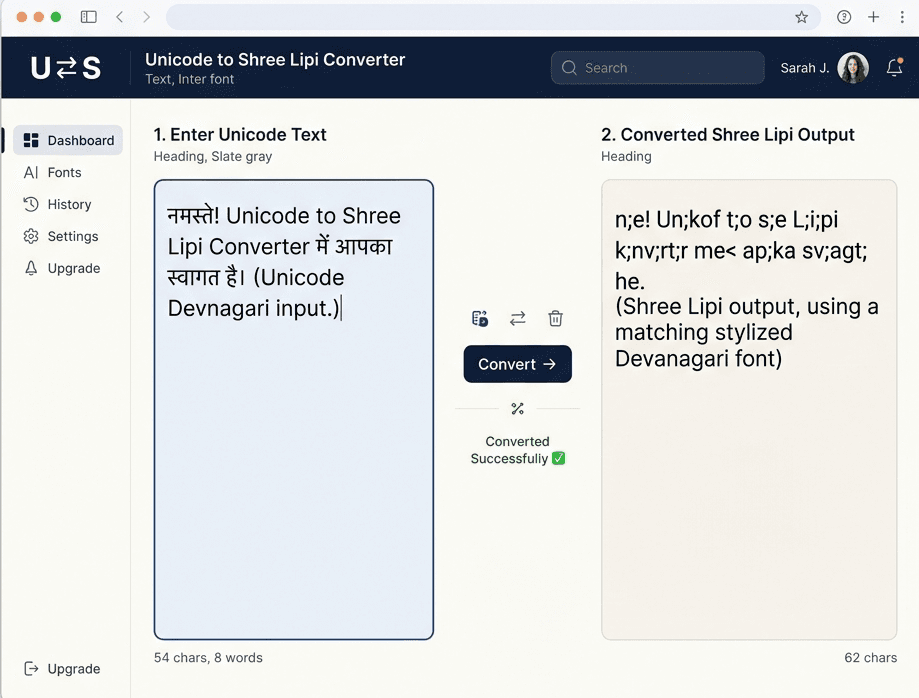
Our Unicode to Shree Lipi Converter at unicodetoshreelipi.com handles this conversion for the most commonly used Shree Lipi Devanagari fonts — including Shree Dev 0714, one of the most widely used Marathi newspaper fonts in the Shree Lipi system. The tool is free, works entirely in the browser, requires no software installation, and handles the full range of Hindi and Marathi characters, including conjuncts, matras, and half-forms.
For designers working with AMS calligraphy fonts — the artistic Hindi font system used in CorelDRAW for wedding cards and decorative design — the Unicode to AMS Converter at unicodetoshreelipi.com/ams-converter provides the same bridging function. Type or collect your text in Unicode, convert to AMS encoding, and use it in CorelDRAW with the correct AMS font applied.
These conversion tools exist because the legacy-to-Unicode transition in Indian printing is not instantaneous. It is a decades-long process, and during this transition, professionals need to move content efficiently between both worlds.
Shree Lipi in the Modern Era — NXT Plus and Beyond
Modular Infotech has not stood still while the industry shifted toward Unicode. The Shree Lipi NXT Plus release represents a thoughtful adaptation — keeping the legacy font library and DTP capabilities intact while adding bridges to the modern Unicode world.
NXT Plus adds Unicode composition mode, allowing users to type directly in Unicode within the Shree Lipi environment and use the system's built-in conversion tools to produce legacy font output when needed. It also adds compatibility with open-source applications including LibreOffice, Inkscape, GIMP, and Scribus — extending Shree Lipi's reach beyond the traditional Adobe and Corel ecosystem.
The spell checker, now included in NXT Plus, works with both legacy two-byte Shree Lipi font encoding and Unicode — a practical tool for editorial workflows in Marathi and Hindi publishing.
The broader Modular Infotech font catalog has also evolved. The company now offers OpenType Devanagari fonts through MyFonts and other global font marketplaces, serving the international design community and major technology companies. Their fonts are used by Google, Microsoft, Apple, and Red Hat — a remarkable evolution from a Pune-based DTP software company to a global Indic type foundry.
Conclusion
The history of Shree Lipi is the history of Indian language computing itself. From the early challenge of rendering complex Devanagari script on hardware designed for Latin alphabets, through the golden age of print DTP in the 1990s and 2000s, to the Unicode transition and the evolution of NXT Plus — Shree Lipi has adapted continuously while maintaining the core of what made it indispensable: a vast, high-quality library of Indian language typefaces and a reliable DTP workflow.
Three decades of content creation means that Shree Lipi is not going anywhere soon. Professionals who work in Hindi and Marathi printing will continue to encounter Shree Lipi files, Shree Lipi templates, and Shree Lipi workflows for years to come.
For anyone who needs to move between the Unicode world and the Shree Lipi world — whether converting modern Unicode text for use in a legacy printing workflow, or extracting content from Shree Lipi archives into Unicode for digital use — our free Unicode to Shree Lipi Converter is the practical tool for this daily professional need.
Related Guides
Frequently Asked Questions
Ready to convert? Our main tool handles Unicode ↔ Shree Lipi with the same accuracy and speed — instantly in your browser.
Try Unicode ↔ Shree Lipi Converter