How to Type Tamil Using Bamini Layout (2026)
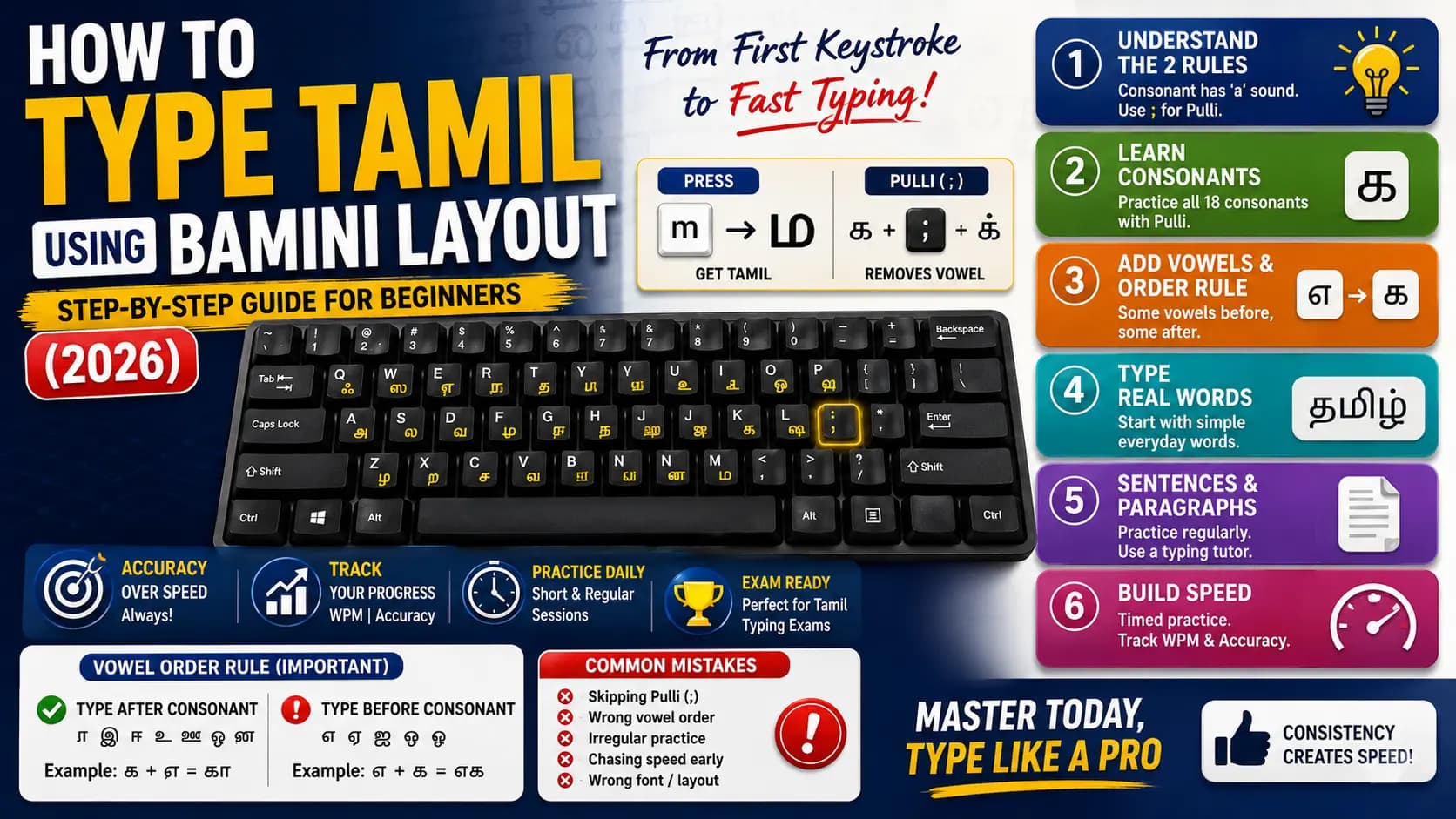
Every fast Bamini typist started exactly where you are now — looking at an English keyboard with no idea which key produces which Tamil letter. The good news is that Bamini typing speed is not about talent. It is a skill built through a specific, repeatable practice order. Skip steps, and progress stalls. Follow the right order, and speed builds naturally within weeks.
This guide walks through that exact order — from your very first Tamil keystroke to exam-ready, professional typing speed.
Table of Contents
- Step 1 — Understand the Two Rules Before You Type Anything
- Step 2 — Learn Consonants Before Vowels
- Step 3 — Add Vowels, and Learn the Order Rule Early
- Step 4 — Move to Real Words
- Step 5 — Practice With Full Sentences and Paragraphs
- Step 6 — Build Speed With Timed Practice
- Common Mistakes That Slow Down Progress
- How Long Does It Take to Get Fast?
- Conclusion
- Frequently Asked Questions
Step 1 — Understand the Two Rules Before You Type Anything
Before touching the keyboard, learn these two rules. Almost every beginner mistake traces back to one of them.
Rule 1: Every consonant already carries a vowel sound. In Bamini, pressing a consonant key doesn't give you a bare consonant — it gives you the consonant plus the "அ" sound built in.
Rule 2: To remove that vowel sound, press the semicolon key right after the consonant. This applies the Pulli mark ், giving you a pure consonant with no vowel attached.
These two rules alone explain most of what beginners find confusing in the first week.
Step 2 — Learn Consonants Before Vowels
Start with consonants alone, using the Pulli key to practice pure consonant sounds. Don't jump into full words yet. The goal in week one is simple: your fingers should find each consonant key without looking down.
Practice in short, repeated bursts — five minutes of consonants, several times a day, works better than one long session. This is how muscle memory actually forms.

💡 Pro Tip for Beginners
Keep a Bamini Keyboard Layout chart next to your screen for the first few days, but force yourself not to look at it unless you are completely stuck. If you ever want to check your typing accuracy, convert your target word using a unicodetobamini tool on unicodetoshreelipi.com to see the exact Bamini keystrokes needed.
Step 3 — Add Vowels, and Learn the Order Rule Early
Once consonants feel automatic, add vowels. Here's the part that separates smooth typists from frustrated ones: vowel typing order follows how Tamil is written, not how it sounds.
- Vowels like ா, ி, ீ, ு, ூ are typed after the consonant — matching how they appear on paper.
- Vowels like எ, ஏ, ஐ are typed before the consonant — because that's how they're written by hand, even though the consonant is spoken first.
Practice both types separately before mixing them. Trying to learn this rule "on the fly" while typing real sentences is the single biggest reason beginners plateau early.
Step 4 — Move to Real Words
Once consonant-vowel combinations feel natural, switch to short, everyday Tamil words. Type slowly and accurately — resist the urge to rush. At this stage, accuracy matters far more than speed. A typist who is 95% accurate at a moderate pace will out-improve a typist who is 60% accurate and fast, every time, because errors compound and slow down real work later.
Step 5 — Practice With Full Sentences and Paragraphs
After words feel comfortable, move to full sentences, then short paragraphs. This is also the stage where a structured typing tutor becomes genuinely useful — most Bamini typing tutors track gross WPM, net WPM, and accuracy percentage after every test, so you can see real numbers instead of guessing at your progress.
Use randomized or varied practice paragraphs rather than memorising the same one repeatedly — memorised text inflates your apparent speed without building real typing ability.
Step 6 — Build Speed With Timed Practice
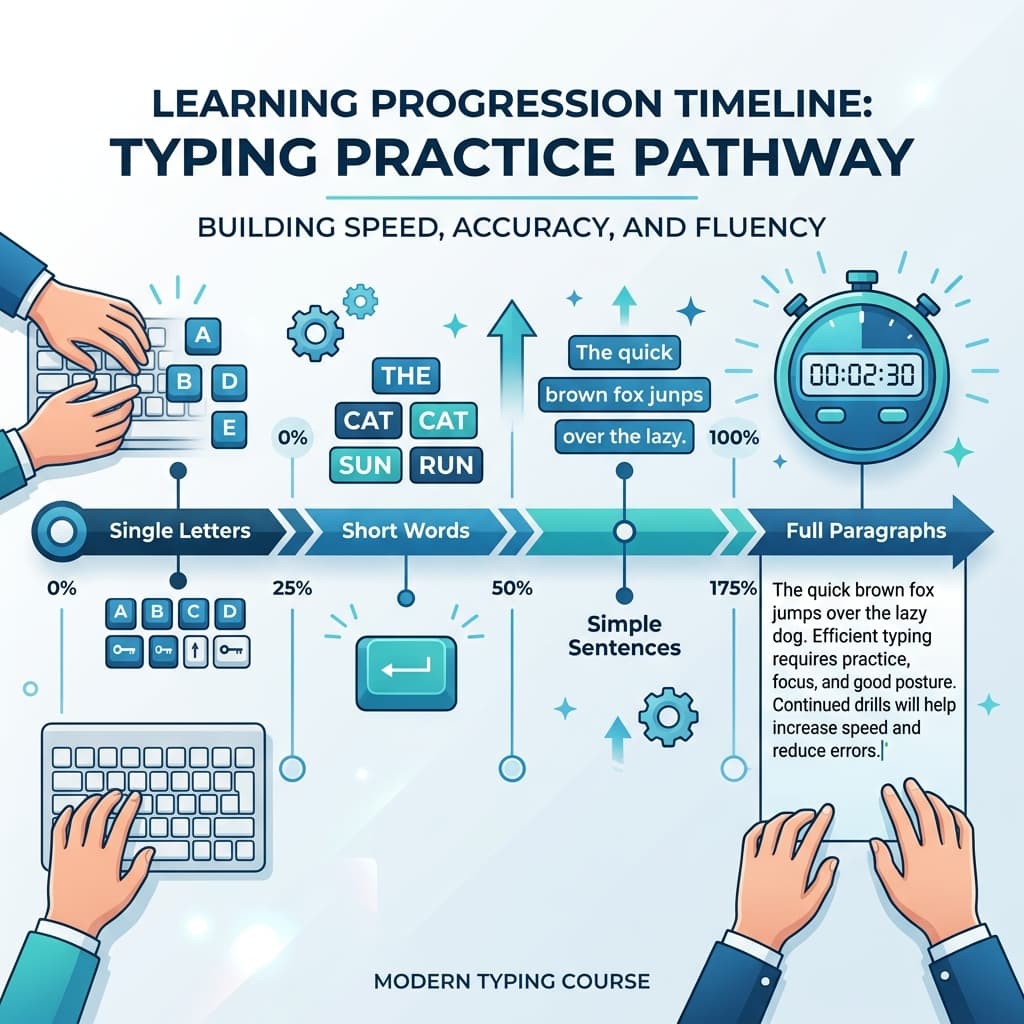
Once you're comfortable typing accurately, start timing yourself. Begin with short one- or two-minute tests, then work up to five- and ten-minute sessions. Track your WPM and accuracy every single session — the trend line matters more than any single result.
For anyone preparing for a government or TNPSC-style Tamil typing exam, this stage should closely mirror the real test — same time limits, same paragraph style, same pressure of being timed.

Common Mistakes That Slow Down Progress
🔴 Problem: Skipping the Pulli key
Cause: Forgetting that Bamini consonants carry a hidden vowel.
Solution: Press the semicolon key immediately after the consonant to remove the unwanted vowel sound.
🔴 Problem: Typing vowels in spoken order instead of written order
Cause: Relying on how the word sounds (phonetic typing).
Solution: Pre-base vowels (எ, ஏ, ஐ) must be typed before the consonant key.
🔴 Problem: Practicing only occasionally
Cause: Trying to cram typing practice into one long session per week.
Solution: Short, daily 15-minute practice builds muscle memory much faster.
🔴 Problem: Chasing speed before accuracy
Cause: Wanting to see a high WPM number immediately.
Solution: Focus on 95% accuracy first. Speed built on sloppy accuracy collapses under pressure.
🔴 Problem: Typing without the correct Bamini font applied while practicing
Cause: Typing Bamini keystrokes into a Unicode text box.
Solution: Always confirm your software renders true Bamini output. You can use unicodetoshreelipi.com to verify encodings.
How Long Does It Take to Get Fast?
There's no fixed number, but a realistic pattern for consistent daily practice looks like this: basic consonant-vowel comfort within one to two weeks, confident short-word typing within a month, and exam-ready paragraph speed within two to three months of regular, focused practice. Typists aiming for professional DTP or government exam speed generally need several months of sustained practice beyond that to reach top-tier WPM.
Key Takeaways
- ✅ Learn the Pulli rule: Master the semicolon key and vowel typing order before anything else.
- ✅ Consonants first: Master consonant positions before adding vowels or attempting full words.
- ✅ Accuracy over speed: Typing 95% correctly at a slow pace is better than typing 60% correctly fast.
- ✅ Track your progress: Use dedicated typing tutors to track WPM and accuracy numerically.
- ✅ Practice consistency: Practice daily in short, 10–15 minute bursts for optimal muscle memory formation.
- ✅ Tooling: Keep a reliable unicodetobamini converter handy (like unicodetoshreelipi) to test and translate your work.
Conclusion
Fast Bamini typing isn't a talent — it's a sequence: rules first, then consonants, then vowels with correct ordering, then words, then timed paragraphs. Follow that order, practice daily even in short bursts, and prioritise accuracy over speed at every stage. For the full breakdown of how the Bamini key map works before you start practicing, see our complete Bamini Keyboard Layout guide.
And if you ever need to convert your Bamini typed work for web usage or back to Unicode, you can always rely on the Unicode to Bamini Converter to bridge the gap effortlessly.
Frequently Asked Questions
Ready to convert? Our main tool handles Unicode ↔ Shree Lipi with the same accuracy and speed — instantly in your browser.
Try Unicode ↔ Shree Lipi Converter